As a certified RMC Solutions trainer and owner of a Project Management Training business, I often guide students and professionals through the maze of project management methodologies. Choosing the right approach can make or break a project—especially when navigating the PMP exam or applying PMBOK 7 principles in real-world scenarios.
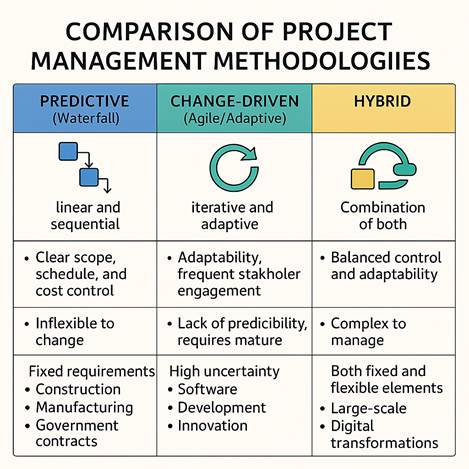
In this post, we’ll explore the three primary methodologies—Predictive, Change-Driven, and Hybrid—highlighting their strengths, limitations, and ideal use cases. This comparison is grounded in the PMBOK® Guide – Seventh Edition and the RMC PMP Exam Prep Eleventh Edition, and is enhanced with a visual summary for quick reference.
? Predictive Project Management (Waterfall)
Overview:
Predictive methodology follows a linear and sequential process. Each phase—Initiation, Planning, Execution, Monitoring & Controlling, and Closing—is completed before the next begins.
Key Characteristics:
- Clear scope, schedule, and cost control
- Minimal stakeholder engagement after planning
- Inflexible to change once execution begins
Best For:
Projects with fixed requirements, such as:
- Construction
- Manufacturing
- Government contracts
PMBOK 7 Insight:
Predictive approaches align with performance domains like Planning and Delivery, emphasizing process tailoring and governance.
? Change-Driven Project Management (Agile/Adaptive)
Overview:
Change-driven methodologies are iterative and adaptive, focusing on frequent stakeholder collaboration and incremental delivery.
Key Characteristics:
- High adaptability to change
- Continuous feedback loops
- Requires team maturity and agile mindset
Best For:
Projects with high uncertainty, such as:
- Software development
- Innovation initiatives
- Startups and R&D
PMBOK 7 Insight:
Agile practices are embedded in domains like Team, Stakeholders, and Uncertainty, promoting value delivery and collaborative leadership.
? Hybrid Project Management
Overview:
Hybrid methodology blends predictive structure with agile flexibility, allowing teams to tailor their approach based on project components.
Key Characteristics:
- Balanced control and adaptability
- Complex governance and coordination
- Requires skilled leadership and integration
Best For:
Projects with both fixed and evolving elements, such as:
- Large-scale digital transformations
- Enterprise software rollouts
- Strategic initiatives with phased delivery
PMBOK 7 Insight:
Hybrid models reflect the tailoring principle, encouraging practitioners to combine tools and techniques from multiple approaches to optimize outcomes.
? Visual Comparison Chart
? SEO Keywords to Target:
- Predictive vs Agile project management
- Hybrid project management methodology
- PMBOK 7 project management approaches
- RMC PMP exam prep comparison
- Waterfall vs Agile vs Hybrid
- Project management training blog
? Final Thoughts
Whether you’re preparing for the PMP exam or leading a complex initiative, understanding these methodologies is essential. The PMBOK 7 Guide encourages tailoring your approach, and the RMC PMP Exam Prep Eleventh Edition provides practical insights to help you do just that.
If you’re a student or professional looking to deepen your understanding, consider joining one of our PMP Exam Prep courses or exploring our Agile mindset study guides. Go to http://www.bmtconsulting.net or email jamesbrock@bmtconsulting.net.